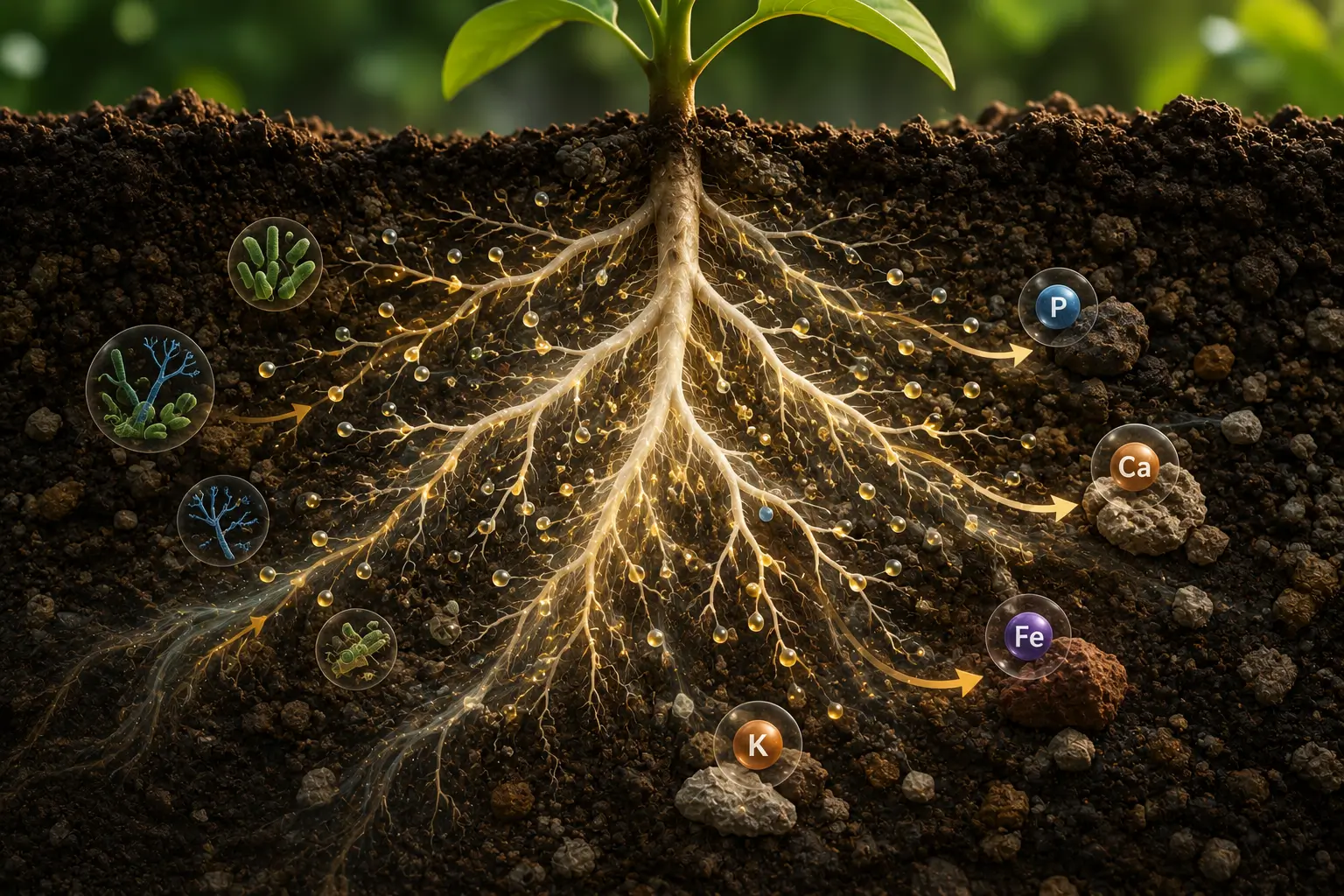
Root Exudates: The Natural Mining System That Solubilizes Soil Nutrients
Plants are not helpless organisms that cling passively to the soil, waiting for nutrients to arrive with water. On the contrary, they are flawless engineers actively altering the chemistry and biology of the soil to secure their own food. The most powerful weapon in this engineering feat is root secretions, scientifically known as exudates.
How minerals locked in the soil in insoluble forms are made available for plant uptake is one of the most fascinating topics in modern agriculture. In this blog post, we deeply explore how these special fluids secreted by plant roots solubilize soil nutrients and their critical role in plant nutrition.
1. What Exactly Are Root Exudates?
Photosynthesis is not solely for growing leaves or producing fruit. Plants pump 20% to 40% of the carbohydrates (sugars) they produce via solar energy directly back into the soil through their roots. This massive energy transfer is the foundation of the plant’s survival strategy.
-
The Liquid Carbon Pathway: Root exudates are a rich “liquid carbon” cocktail largely consisting of sugars, organic acids, amino acids, enzymes, and vitamins.
-
Shaping the Rhizosphere: The 1-2 millimeter layer of soil immediately surrounding the roots is called the “rhizosphere.” Root exudates transform this narrow zone into a dynamic and hyper-active chemical laboratory, completely different from the rest of the bulk soil.
-
Custom Production on Demand: A plant does not produce exudates blindly. For example, the chemicals secreted by the roots of a plant suffering from iron deficiency are entirely different from those of a plant suffering from phosphorus deficiency. The plant dictates the menu based on its immediate needs.
2. Chemical Mining: The Solubilizing Power of Organic Acids
Most minerals in the soil (especially phosphorus, iron, and zinc) are trapped in hard rocks or bound by strong chemical bonds (locked up with calcium or aluminum) that plants cannot directly absorb. Root exudates are the keys that open these locks.
-
Localized pH Reduction: Plant roots secrete potent organic acids such as citric acid, malic acid, and oxalic acid. These acids rapidly lower the pH of the soil only in the microscopic area where the root tip touches. In this acidified environment, locked calcium phosphate or rock phosphate dissolves, transforming into the liquid orthophosphate form the plant can absorb.
-
The Chelation Mechanism: Organic acids also act as natural chelators (claws). They chemically wrap around oxidized and petrified iron (Fe+3) or zinc (Zn) ions in the soil, detach them from soil particles, and transport them in a form that can enter the plant root.
-
Neutralizing Toxic Elements: Root exudates do not just solubilize nutrients; they also serve as a defense shield. Aluminum ions, which reach toxic levels in acidic soils, are bound by the organic acids secreted by the roots and rendered harmless.
3. The Biological Bridge: Feeding the Soil’s Living Army
Plants use a large portion of their root exudates not to dissolve minerals directly, but to feed a massive “microbial army” that will do the job for them.
-
A Custom Menu for Microorganisms: Bacteria and fungi in the soil need energy (carbon), but they cannot photosynthesize. Through root exudates (sugars and amino acids), the plant attracts these microorganisms to the root zone (rhizosphere) and feeds them.
-
Enzymatic Solubilization: Beneficial bacteria and mycorrhizal fungi, fed by the plant’s sugars, secrete powerful enzymes like “phosphatase” into the soil in return. These enzymes break down dead organic matter in the soil, converting the trapped nitrogen, sulfur, and phosphorus into inorganic forms the plant can absorb.
-
Mycorrhizal Fungal Networks: Stimulated by root exudates, mycorrhizal fungi colonize the inside of the plant root and establish extensive hyphal (web) systems that stretch for kilometers in the soil. They transport water, dissolved zinc, copper, and phosphorus from depths the plant cannot reach, continuing to feed on the sugars in the root exudates in return.
4. The Strategic Importance of Root Exudates with the Ekolojik Tarım A.Ş. Vision
This natural cycle, which we place at the center of our production philosophy at Ekolojik Tarım A.Ş., is the only way to reduce dependency on synthetic fertilizers and build sustainable soil health.
-
The Lazy Effect of Synthetic Fertilizers: When high doses of easily soluble synthetic fertilizers (especially phosphorus and nitrogen) are continuously applied to the soil, the plant stops producing root exudates. Why expend energy to produce acids or sugars? This “laziness” causes the microbial life in the rhizosphere to starve and leads to the biological desertification of the soil.
-
The Power of Bio-Diversity: Different plant species produce different root exudates. Cover crops and crop rotation practices pump a variety of root exudates into the soil, exploding microbial diversity. While oat exudates dissolve calcium, legume exudates trigger nitrogen fixation.
-
Long-Term Soil Building: Carbon compounds in root exudates (especially the protein glomalin) act as glue, binding soil particles together and improving the physical structure (aggregation) of the soil. This structure increases the soil’s water-holding capacity, prevents erosion, and stops dissolved nutrients from washing away.