A Practical Way to Read Your Cation Exchange Capacity (CEC) Report
When you get your hands on a soil analysis report, your eyes probably dart first to the amounts of Nitrogen (N), Phosphorus (P), and Potassium (K). However, tucked away near the top of that report is a single, magical number that is often overlooked but determines the true potential of your soil: CEC (Cation Exchange Capacity).
In ecological farming, CEC represents the “size of your soil’s fuel tank” and its “digestive capacity.” Any fertilization you do without correctly reading this value is like trying to hit a target in the dark. In this article, we explain step-by-step what CEC is, the secrets this number whispers about your soil, and how to manage this capacity using the Ekolojik Tarım A.Ş. philosophy.
1. What Exactly is CEC (Cation Exchange Capacity)?
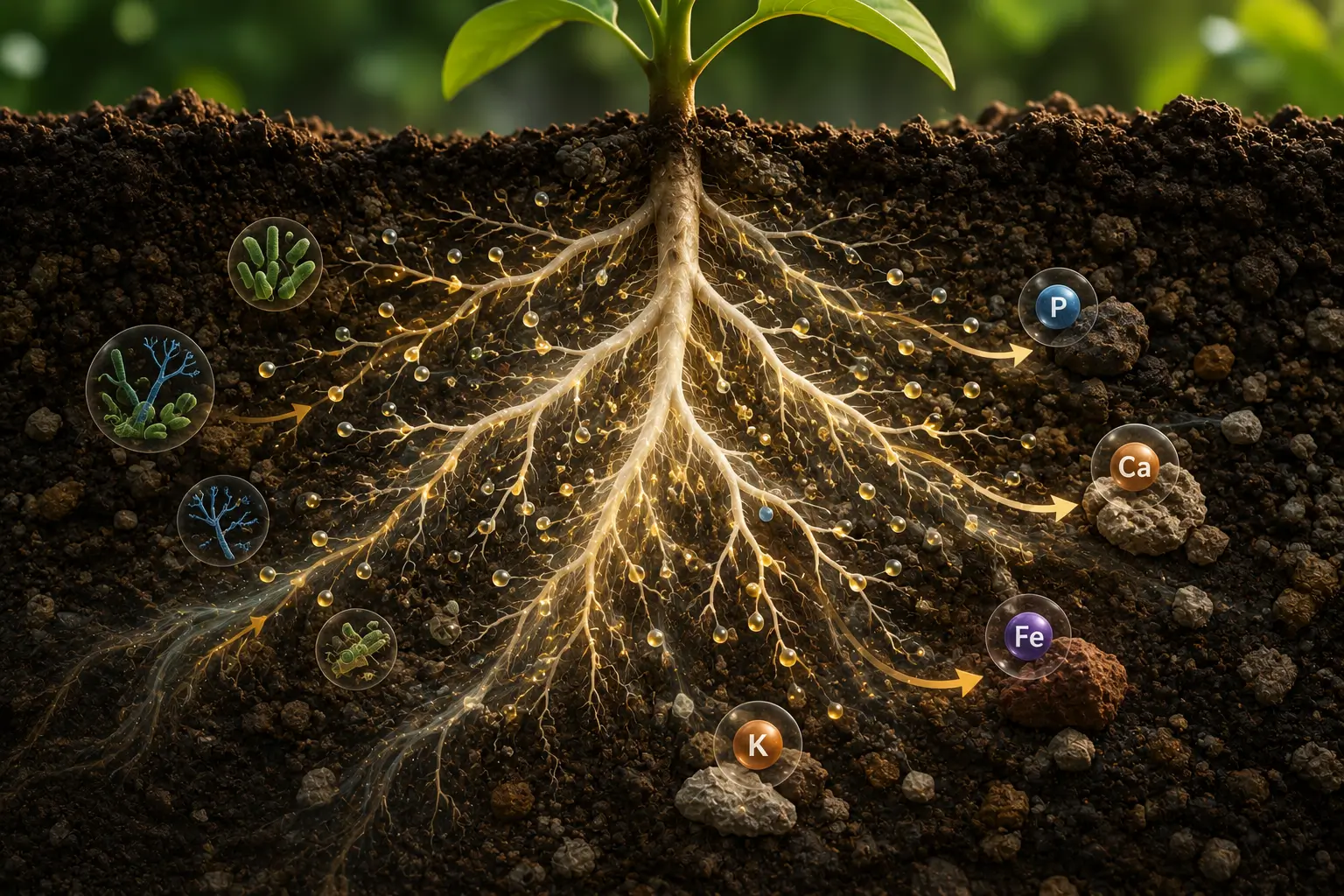
To understand CEC, we must think of the soil at a microscopic level as a giant field of magnets. This mechanism is the primary insurance that prevents your plants from starving or suffering from element toxicity.
-
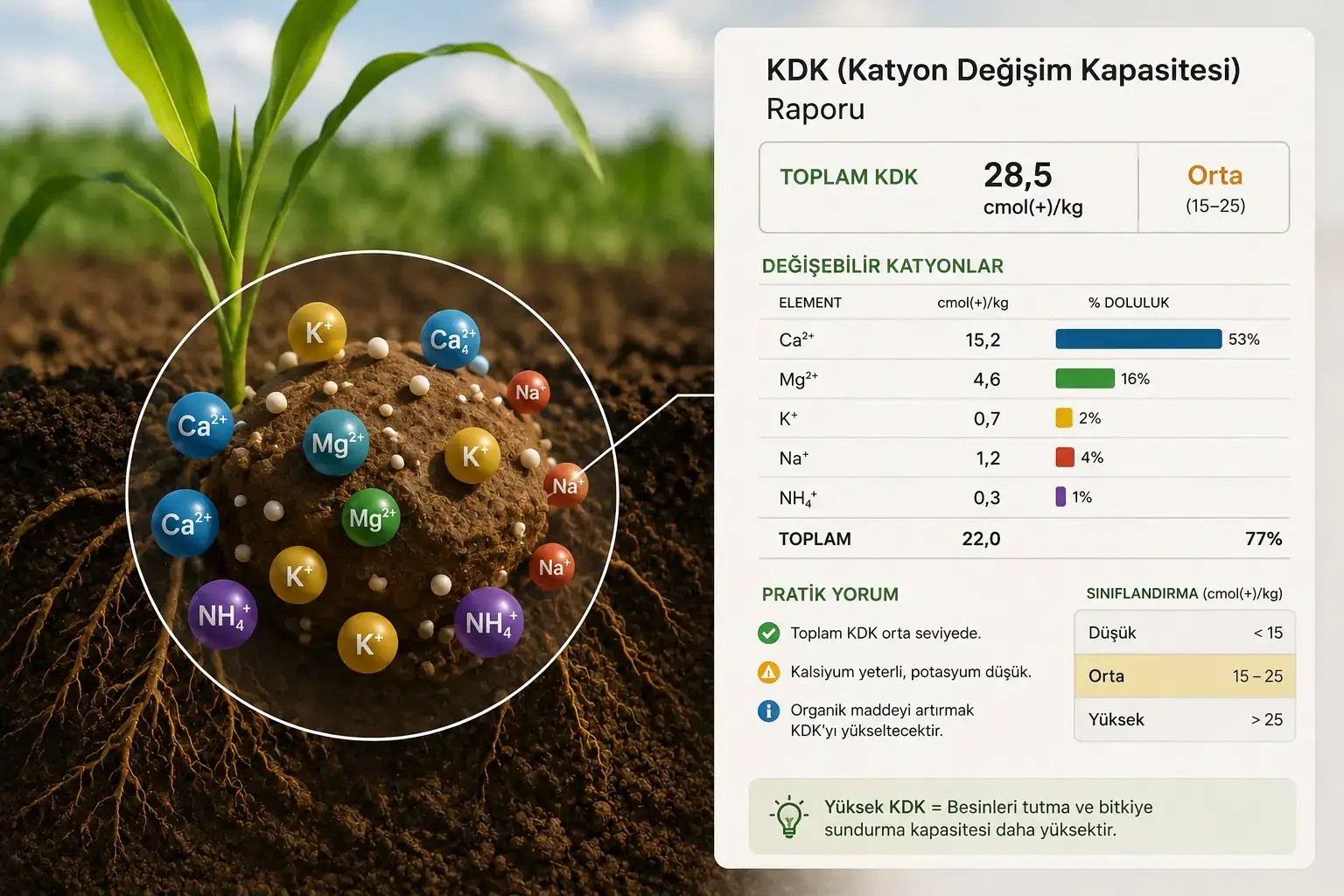
Negatively Charged Soil, Positively Charged Nutrients: Clay minerals and organic matter (humus) in the soil have a negative (-) electrical charge. Essential plant nutrients like Calcium (Ca++), Magnesium (Mg++), Potassium (K+), and Sodium (Na+) are positively (+) charged ions (cations). The soil binds these nutrients to itself, just as opposite poles of a magnet attract, preventing them from washing away with rainwater.
-
The Size of the Tank: CEC is the mathematical measurement of your soil’s capacity to hold these positively charged nutrients and release them back to the plant when needed. The higher the CEC value, the larger the soil’s nutrient-holding “tank.”
-
Buffering Power: Soil with high CEC acts as a massive shock absorber (buffer) against sudden pH changes, over-fertilization, or drought stress. It tolerates mistakes and protects the plant.
2. Reading the Numbers: Which Category is Your CEC Value In?
The CEC value on your analysis report is generally expressed in meq/100g (milliequivalents per 100 grams of soil). By looking at this number, you can analyze your soil’s character in seconds:
-
Low CEC (Between 1 and 10): This indicates that your soil is excessively sandy and extremely poor in organic matter. The tank is very small. It cannot hold nutrients and water. Applying a large amount of fertilizer to this soil all at once is throwing your money away, as the excess fertilizer cannot attach and will wash into groundwater. Strategy: Spoon-feeding (small amounts, frequently) should be applied.
-
Medium CEC (Between 11 and 20): Ideal agricultural soils (loamy soils) usually fall in this range. They have enough clay and humus to hold water and nutrients, but are permeable enough so roots can breathe easily and water doesn’t pool. Strategy: Standard ecological fertilization programs yield the best results in this range.
-
High CEC (Between 21 and 50+): These are very heavy, clayey soils. Their nutrient holding capacity (tank) is enormous. However, because these soils drain water very slowly, they carry risks of mudding and root rot. Soil warming is delayed. Strategy: Instead of loading these soils with nutrients, coarse organic matter (based on straw or woody compost) should be added to aerate the physical structure.
3. “What’s Inside” Matters as Much as the Tank’s Size: Base Saturation Ratios
CEC only tells you how many liters the tank is. However, the real issue in ecological farming is what kind of fuel this tank is filled with. This is where the Base Cation Saturation Ratio (BCSR) comes into play.
-
In Pursuit of Ideal Ratios: Scientific research shows that the seats on the soil’s CEC magnets must be shared in a specific ratio. In ideal soil, 60-70% of these seats should be filled with Calcium, 10-15% with Magnesium, and 2-5% with Potassium. The remaining parts are filled with trace elements and hydrogen (acidity).
-
What Happens When Ratios Go Awry?: Let’s say your CEC value is 25 (Very good). But when you look at the analysis, you see that 40% of this capacity is filled with Magnesium and 10% with Calcium. This means your soil will compact like concrete, crack, and the plant will succumb to diseases due to calcium deficiency. The tank is large, but it’s filled with the wrong element.
-
Balancing Intervention: When you read this imbalance (e.g., calcium deficiency) in your report, you intervene directly at the soil’s CEC points using ecological farming practices. By applying gypsum (calcium sulfate) or agricultural lime, you rip the excess magnesium off the magnet and replace it with calcium, essentially rebuilding the soil.
4. The Secret to Increasing CEC Ecologically
It is practically impossible to turn clay soil into sandy soil or sandy soil into clay soil (meaning, changing the soil’s mineral texture). So, how do we enlarge the nutrient tank of a low-CEC (sandy) soil? The answer is single and clear: Organic Matter.
-
The Multiplier Effect of Humus: While the CEC of pure clay ranges between 10 and 40 depending on its type, the CEC of well-decomposed organic matter (humus) is over 200. Meaning, a 1% increase in organic matter you add to your soil geometrically multiplies the soil’s nutrient and water holding capacity.
-
Using Biochar: Biochar, the shining star of ecological farming, is an incredible tool that permanently increases the soil’s CEC thanks to its millions of microscopic pores and high negative electrical charge.
-
Cover Crops and Compost: Never leaving the soil bare (using cover crops) and integrating high-quality, matured composts adhering to Ekolojik Tarım A.Ş. standards will, over time, transform even low-capacity sandy soils into high-yielding nutrient reservoirs.