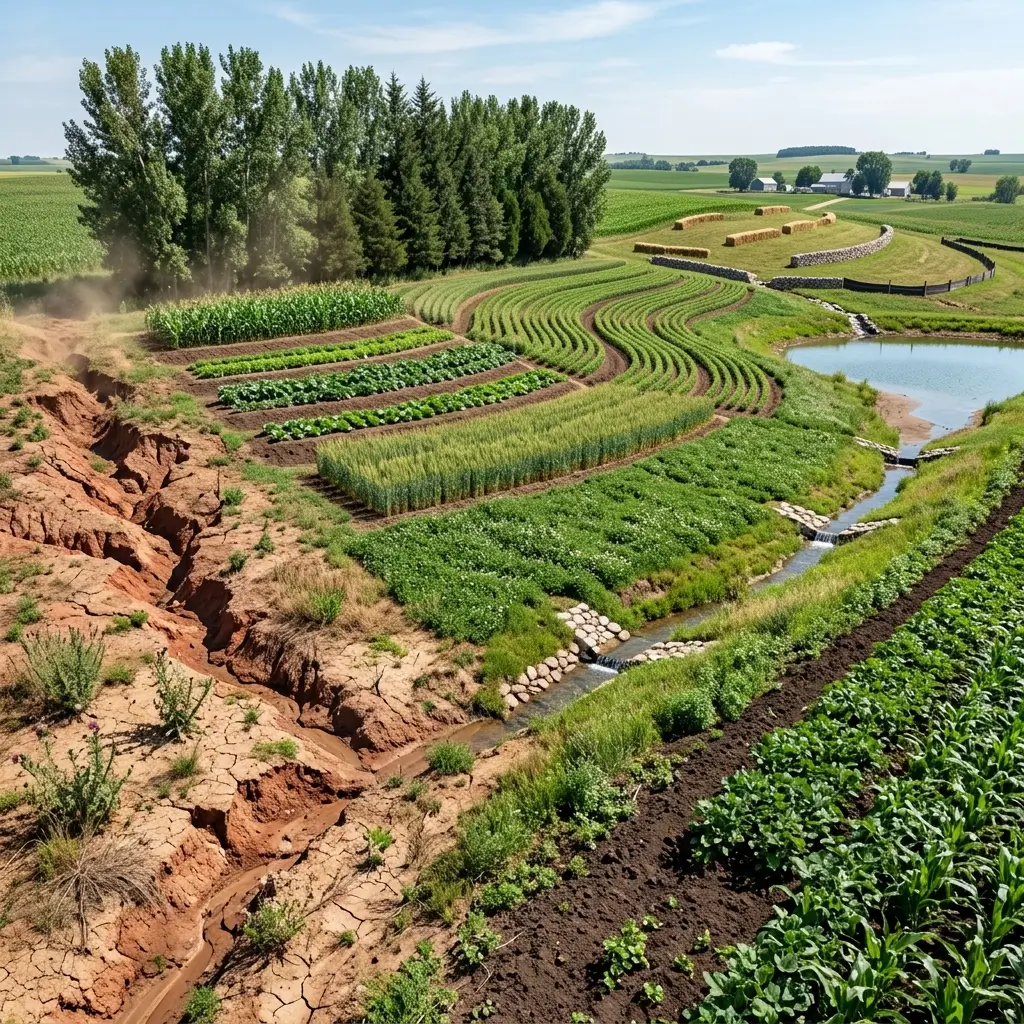
Soil Erosion Prevention: The Essential Defense of Productive Farming
Soil erosion ranks among the most serious threats to agriculture. Millions of tons of fertile soil are lost annually due to water and wind erosion. Soil loss caused by erosion not only threatens current production but also reduces the land where future generations can farm and causes environmental problems. Combating erosion has become one of the most important practices in modern and ecological agriculture. In this article, we will examine in detail the causes of soil erosion, its consequences, and effective control methods.
Causes of Erosion
Soil erosion is triggered by two fundamental factors: water erosion and wind erosion. Water erosion occurs when rain drops strike the soil, and subsequently flowing water carries away the soil. On sloped land, water flowing after rainfall gains speed, turning into streams and creek channels, causing massive soil loss. Wind erosion occurs especially on saline, arid, and windswept areas. Winds lift the top layer of soil and carry it elsewhere, creating barren areas.
Factors contributing to erosion:
- Bare soil surface (without vegetation cover)
- Sloped terrain
- High precipitation areas (water erosion)
- Arid, windy regions (wind erosion)
- Intensive farming and monoculture
- Heavy mechanical operations
- Loss of forests and pasture areas
Effects of Erosion
The effects of soil erosion manifest across a wide range:
Agricultural Effects:
- Decrease in soil productivity
- Reduction in crop yield
- Increased demand for agricultural inputs (fertilizers, water)
- Rising production costs
Environmental Effects:
- Loss of forests and pasture areas
- Qualitative degradation of water sources (sedimentation, pollution)
- Damage to freshwater ecosystems
- Reduction of farmland and risk of desertification
- Decrease in livestock area productivity
Social and Economic Effects:
- Rural population migration
- Weakening of local economy
- Threat to food security
- Increase in poverty
Strategy 1: Vegetation Cover Protection and Enhancement
Vegetation cover is the most effective protection for soil. Plants prevent rain drops from striking soil directly, keep soil particles together with their roots, and slow water runoff.
Vegetation cover applications:
- Forest planting: Tree planting on erosion-prone lands
- Pasture improvement: Planting special grasses and legumes to increase pasture productivity
- Crop rotation: Planting changing crops yearly, keeping soil mostly covered
- Green manure: Planting ecological crops after harvest (legumes)
- Mulching: Retaining harvest residues on soil surface
- Afforestation: Planting various trees along edges of farmland
Strategy 2: Topographic Control Methods
On sloped terrain, topographic arrangements minimize erosion.
Topographic control methods:
- Terrace formation: Sloped land is transformed into horizontally stepped areas
- Terrace edges: Plants are planted on each terrace (shrubs, trees)
- Contour strips: Planting different crops in strips perpendicular to slope
- Sloped strips: Strips following contours with slight slope
- Water retention structures: Physical barriers to control erosion-related water flow
- Channels and drainage: Waterways, ditches, and channels to control water flow
Strategy 3: Modifying Tillage Methods
Soil tillage method directly impacts erosion.
Erosion-reducing tillage methods:
- Reduced Tillage: Limited tillage instead of conventional detailed tillage
- No-till: Planting seeds or seedlings without any soil disturbance
- Strip tillage: Tilling only in planting strips, leaving plant residues in spaces
- Contour tillage: Tilling perpendicular to slope
- Reducing tillage depth: Avoiding deep tillage
These methods protect soil’s top layer while reducing labor and fuel costs.
Strategy 4: Physical Barriers and Structures
In some cases, constructing physical barriers becomes necessary.
Examples of physical barriers:
- Stone monuments and walls: Stone walls along sloped land edges
- Bamboo fences: Bamboo or mat fences to control wind erosion
- Sediment traps: Ponds to capture soil carried by water from farmland
- Farm pond dams: Water-catching structures at field ends
- Windbreaks: Windbreak trees, if wind erosion is serious
Strategy 5: Water Management and Irrigation
Water management is important both for controlling erosion and practicing sustainable farming.
Water management applications:
- Infiltration bunds: Structures allowing rainwater to seep into soil
- Bench terraces: Arranging sloped land into step shapes
- Slow irrigation: Controlled irrigation instead of sudden water flow
- Drip irrigation: Point irrigation systems
- Rainwater harvesting: Storing and using rainwater
Strategy 6: Agroforestry
Integrating agriculture and forests controls erosion while providing income.
Agroforestry applications:
- Silvopasture: Grazing animals under trees
- Agro-forest system: Planting trees at regular intervals within farmland
- Alley cropping: Farming between tree strips
- Agroforestry-pasture: Combining trees, plants, and livestock
Conclusion
Preventing soil erosion is critical not only for farmers’ benefit but also for humanity’s and the planet’s future. Combating erosion requires a multi-faceted, integrated approach; no single solution is sufficient. Protecting vegetation cover, topographic arrangements, modifying tillage methods, physical barriers, water management, and agroforestry practices play effective roles in erosion control. Each farmer should prepare an erosion control plan by selecting methods appropriate to their land conditions.